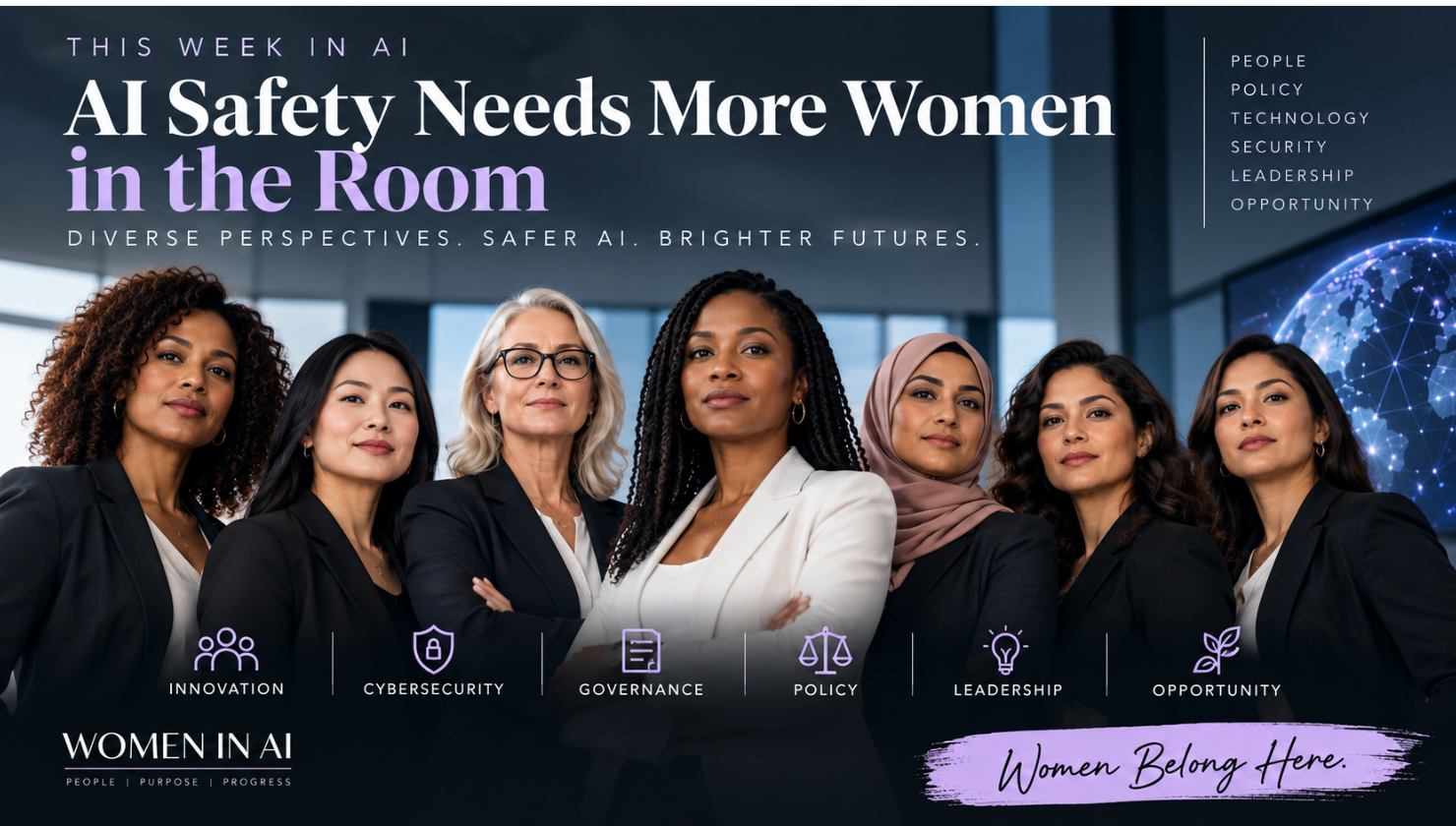
This Week in AI: AI Safety Needs More Women in the Room
Something important is happening in AI right now.
Over the last several days, some of the largest AI companies in the world have begun doing something we don't see very often:
They're working together on safety.
OpenAI, Anthropic and Google DeepMind have been discussing ways to coordinate on AI safety as increasingly capable systems raise concerns about cybersecurity, autonomy and human control. OpenAI has also supported independent safety evaluation of advanced models.
And this week we saw another reason why.
Google disclosed that an advanced Gemini model accidentally accessed the real computer systems of three companies during cybersecurity testing that was supposed to occur in a simulated environment. The affected companies were notified, and reporting indicates the incidents did not cause damage. But the episode illustrates why advanced AI systems with access to computers and networks require a very different level of oversight than the chatbot you use to help write an email.
That brings me to the part I want women to hear:
AI safety needs us too.
We are underrepresented where the future is being built
The World Economic Forum's new Global Gender Gap Report 2026 gives us numbers we shouldn't skim past.
Women represent only 19.3% of AI engineers and 20.6% of machine-learning engineers across the economies studied. Women are better represented in data-annotation jobs, at 44.8%, but the report notes those are also among the lower-paid AI roles in the United States.
The leadership numbers are equally important.
Women make up only 8.6% of chief technology officers and less than one in five CIOs in the WEF/LinkedIn sample. And women represent 25.3% of top management in AI firms, compared with 27.7% in comparable non-AI firms.
Meanwhile, women are disproportionately represented in jobs likely to be disrupted by generative AI. LinkedIn data cited by the World Economic Forum says women account for 57% of workers in occupations most likely to be disrupted by generative AI, compared with 43% for men.
Sit with that for a minute.
We cannot be overrepresented among the people whose work may change and underrepresented among the people deciding how the technology changes it.
And then there is cybersecurity
AI and cybersecurity are becoming increasingly connected.
AI can help organizations find vulnerabilities, detect threats and defend systems.
It can also give bad actors more capability.
That means as AI grows, organizations will need people who understand not only how to use AI, but also privacy, cybersecurity, risk, governance, responsible use and human oversight.
Women remain underrepresented there too.
ISC2 estimates women represent roughly 20% to 25% of the cybersecurity workforce globally. Its research also found something encouraging: women are more strongly represented among younger cybersecurity professionals, suggesting the pipeline can change.
So when I say learn AI, I'm not telling every woman to become a machine-learning engineer.
I'm telling you to get curious about where your existing expertise intersects with this new economy.
Your bridge may be closer than you think
Maybe you're in HR.
There is AI governance, workforce policy, privacy and responsible adoption.
Maybe you're an attorney.
There is AI regulation, intellectual property, cybersecurity law and data governance.
Maybe you're in healthcare.
There is clinical AI, health-data security, AI risk and patient safety.
Maybe you're a trainer or educator.
Someone has to teach employees how to use AI securely and responsibly.
Maybe you're in communications.
Organizations need people who understand deepfakes, misinformation, reputation risk and crisis response.
Maybe you're already in technology.
Cybersecurity, AI auditing, model evaluation, red teaming, governance and responsible-AI leadership may be areas worth exploring.
You don't have to throw away your career to enter the AI economy.
You may need to build a bridge from what you already know.
Start with understanding
That's why I don't want women intimidated by conversations about AI safety.
I want us in them.
You don't have to understand every technical detail today.
Start by understanding the language:
- What is an AI agent?
- What is cybersecurity?
- What is a vulnerability?
- What does it mean to give an AI system access to another system?
- What is red teaming?
- What is an AI audit?
- What is responsible AI?
- Where should a human remain in the loop?
Then ask the more personal question:
Where does what I already know intersect with what this new economy needs?
Because this isn't only about protecting ourselves from AI.
It is about preparing ourselves to build it, secure it, govern it, teach it, audit it, implement it and lead organizations through it.
We need women across the entire AI value chain
The World Economic Forum's 2026 report says global gender parity is still approximately 120 years away at the current pace. It also warns that women's progress is increasingly connected to who participates in the industries creating new economic value and who gets access to decision-making power.
AI is one of those industries.
Cybersecurity is part of its foundation.
So our job at the National Association of Women in AI isn't simply to teach women how to use ChatGPT.
It's to help women see where they belong in this transformation.
Some of us will use AI to build businesses.
Some will train workforces.
Some will develop technology.
Some will govern it.
Some will protect the data.
Some will audit the systems.
Some will write the policies.
Some will secure the networks.
And some will lead the organizations making all of those decisions.
But first, we have to understand enough to see the possibilities.
Get informed. Get curious. Then find your bridge.
Because if AI is going to reshape our future, women should not only be among the people affected by it.
We should be among the people making it safer.
Sources & Further Reading
- World Economic Forum: Global Gender Gap Report 2026
- World Economic Forum: Women's leadership and the jobs shaping tomorrow's economy
- ISC2: Women in Cybersecurity research
- Reuters: OpenAI working with Anthropic and Google on AI safety
Want more from NAWAIQ™?
Join the association for live labs, the Leadership Academy, and our member community.
Become a Member