ChatGPT Has Ads. Here’s What That Means for Your Business.
ChatGPT Ads caught my attention, and my first question was simple: Where are these ads? I use ChatGPT all the time, and I haven’t seen them.
Then I looked at the pricing guidance and had another question: Three to five dollars per click? What exactly am I paying for?
If you haven’t paid for digital advertising before, the language can make this sound more complicated than it needs to be. I’m learning about this, too, so let’s walk through it together.
Why haven’t I seen ads in my ChatGPT?
This cleared up my confusion immediately: ChatGPT Pro and Business are separate plans, and neither shows ads. Plus, Enterprise, and Edu are also ad-free.
Ads may appear for eligible people using the Free or Go plans, depending on their region and availability. OpenAI also excludes accounts identified as belonging to people under 18.
You can be interested in advertising your business on ChatGPT while never seeing ads in your own account.
Where do the ads actually appear?
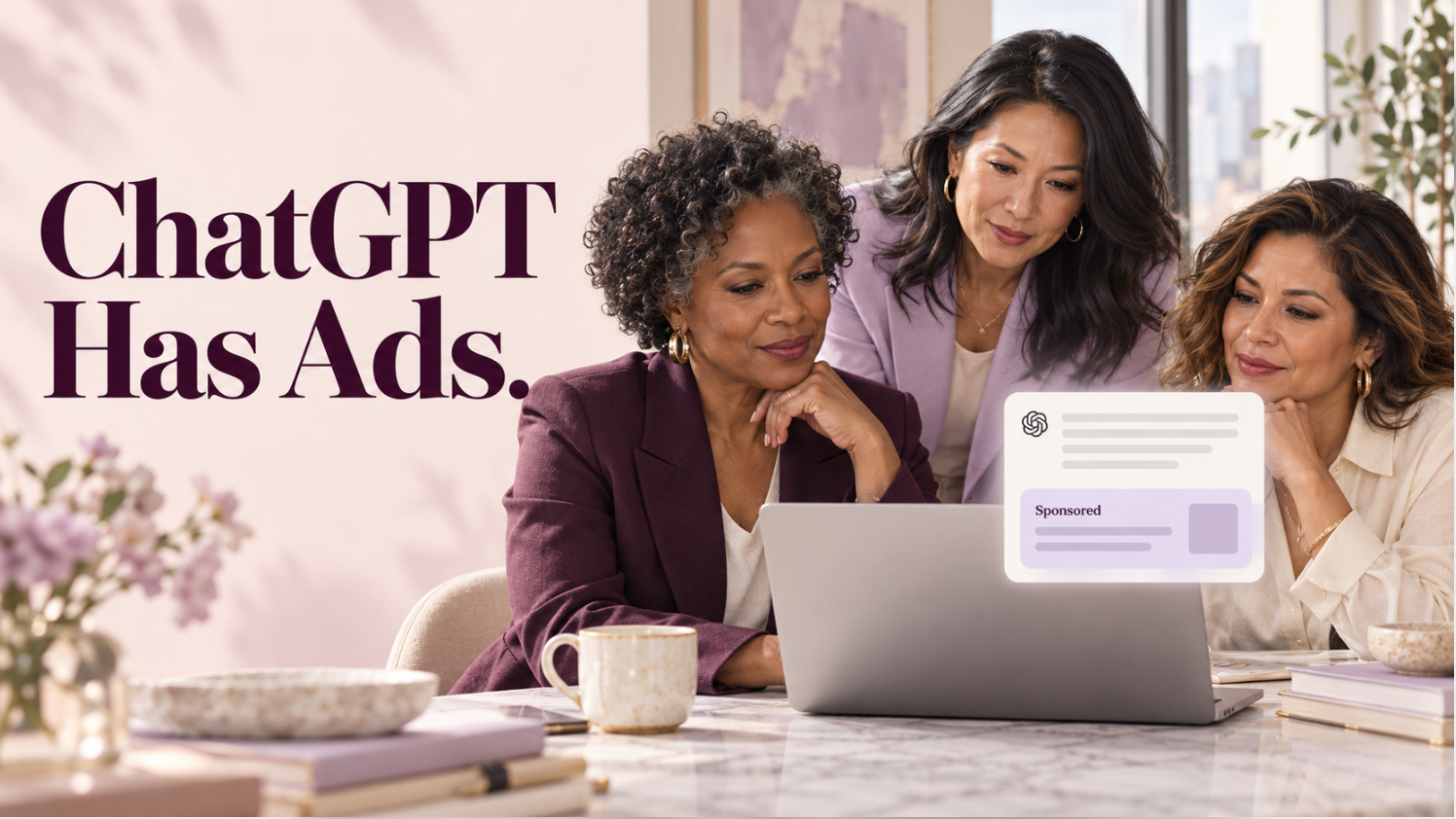
Ads can appear underneath a ChatGPT response, labeled as sponsored and visually separated from the answer. OpenAI says advertisers cannot pay to change, rank, or shape ChatGPT’s responses.
Imagine someone asking ChatGPT how to introduce AI to a small business team. An ad for a beginner-friendly AI workshop could be relevant to that conversation.
That’s an illustration, not a promise that those words will trigger your advertisement. The opportunity is to reach someone while they are working through a need your business could help address.
How do you get an ad posted?
Businesses start at https://ads.openai.com/ and use Ads Manager to create campaigns, set goals and budgets, and add their advertising materials.
The ad format includes your business name, headline, description, image, and a link to a destination page.
Ads must pass review. They can begin running once approved and when billing, account requirements, and campaign settings permit.
What does “bidding for clicks” mean?
Here’s the context I needed: You are competing with other advertisers for an opportunity to show your ad.
OpenAI uses an auction that considers both relevance and advertiser bids. A maximum cost-per-click bid tells the system the most you are willing to pay for a valid click in a standard Clicks campaign.
OpenAI recommends starting with a maximum bid of $3 to $5. That is guidance, not a required price or a guarantee that every click costs that amount.
Think of it this way: You are setting your limit before entering the competition.
Why might one click cost more than another?
This was my next question. Is the system deciding one person is worth $3 and another person is worth $5?
Different advertising opportunities can involve different competition and relevance. A higher click price does not, by itself, tell you that the person is more likely to buy. OpenAI describes a relevance-weighted, second-price auction, but does not publish the complete formula behind individual prices.
For a hypothetical example, suppose you choose a $5 maximum bid. One opportunity might result in a $3 click, while another could cost more, within your maximum.
If you choose a $3 maximum for a standard Clicks campaign, you are not authorizing a $5 click.
Why would I choose a higher bid?
A higher bid can help your ad compete for placement. A bid that is too low may limit delivery. But more visibility does not guarantee more customers.
Before raising a bid, I would ask: What can my business afford to spend to acquire a customer?
Here’s a hypothetical example using an actual average cost of $3 per click:
| Results from 100 clicks | Advertising cost | Cost per customer |
|---|---|---|
| One paying customer | $300 | $300 |
| Five paying customers | $300 | $60 |
The clicks cost the same in both examples. The business results are very different.
That’s why “Is $3 expensive?” needs a second question: “What does that spending produce, and does the profit justify it?”
Do you have to pay per click?
No. OpenAI also offers impression-based advertising, where you pay per 1,000 ad displays.
Eligible advertisers can choose conversion optimization, which works toward actions such as purchases or signups. Even then, billing is based on clicks or impressions. You are not simply paying only when someone buys.
Budget settings also deserve attention. A daily budget is an average, with spending allowed to reach twice that amount on an individual day within the stated seven-day limit. A campaign-total budget provides a maximum for the campaign.
Who can your ads reach?
Campaigns can target supported countries and platforms, including desktop web and mobile experiences. Some new self-service accounts initially have restrictions on advertising outside their home country.
There is no universal promise that a particular budget will reach a certain number of ideal customers. Your audience settings, eligible placements, competition, and spending all matter.
Also, remember who is excluded: an ad cannot reach every ChatGPT user when several subscription plans are ad-free.
What about privacy?
OpenAI says advertisers do not receive users’ private conversations or memories. Users can manage personalization through ad controls. Turning personalization off changes how ads are selected; it does not automatically remove them.
A sponsored placement is still advertising. Treat it with the same judgment you would bring to an ad anywhere else.
Is this something your business should try?
My recommendation is to learn the mechanics before funding the experiment.
Choose one offer, one clear destination page, one measurable goal, and a total amount you are comfortable testing. Then evaluate the inquiries, registrations, or purchases the campaign produces.
I’m interested in reaching people while they are actively exploring a need. I also want to understand what I’m buying before connecting my credit card.
Curiosity is welcome. The marketing budget still gets boundaries.
Information checked October 15, 2026. Features, availability, and pricing options may change.
Want more from NAWAIQ™?
Join the association for live labs, the Leadership Academy, and our member community.
Become a Member