A New AI Job Is Emerging. Women Should Be Preparing for It.
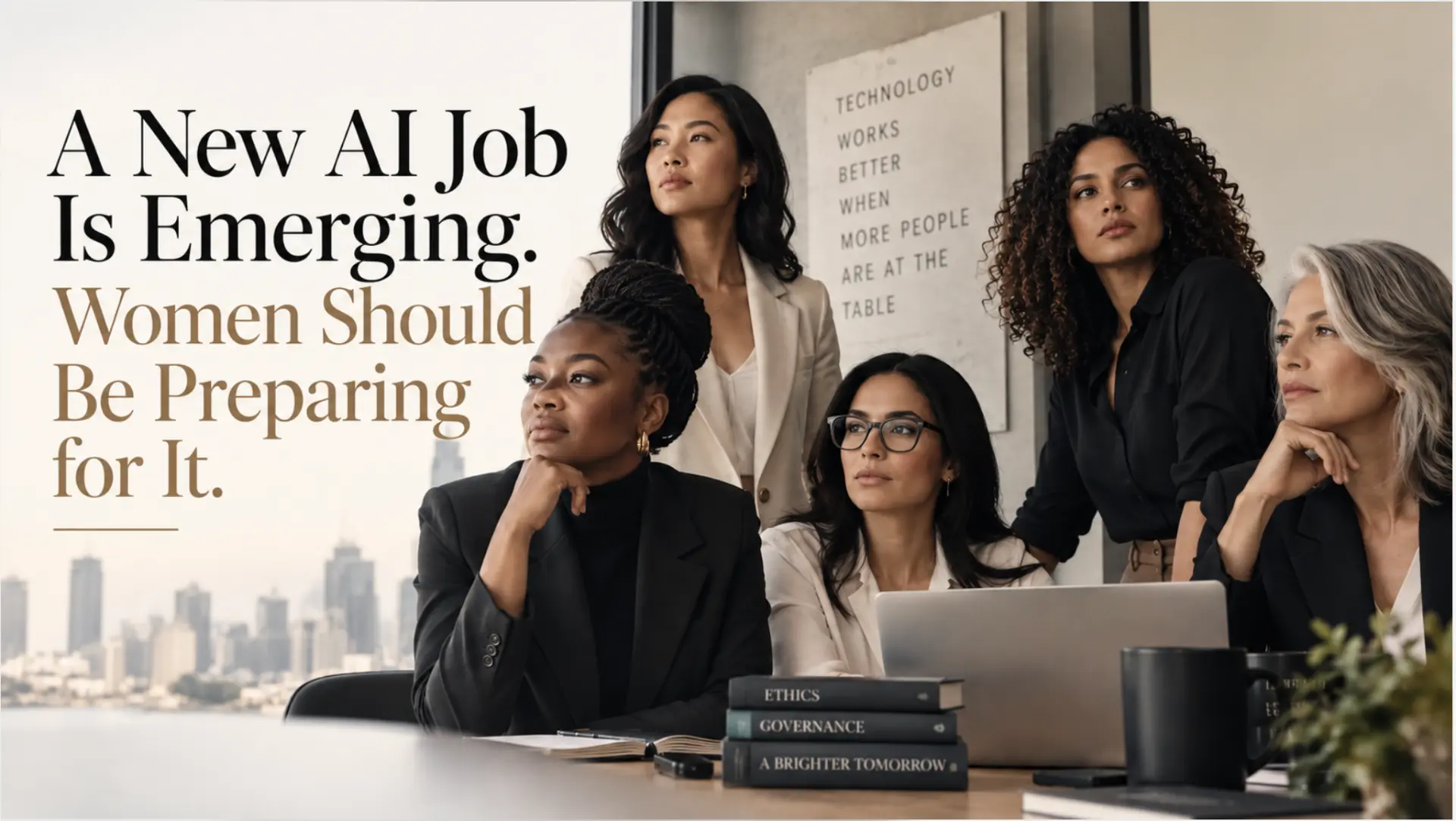
Imagine this.
You've spent 15 years in HR, compliance, healthcare, education, risk, organizational development, law, finance or leadership.
You understand people. You understand systems. You know how to ask uncomfortable questions. You can recognize when something doesn't quite add up. You know how to document decisions, evaluate risk and explain complicated information to people who don't live in the technical weeds.
Then AI arrives.
And somewhere along the way, you start thinking:
"Where exactly do I fit in this?"
Here is one answer I want women paying attention to:
AI evaluator.
AI evaluator is an emerging career field focused on testing whether advanced AI systems are safe, reliable and operating within appropriate boundaries. For experienced women in compliance, risk, HR, law, healthcare, education and leadership, it may represent a new AI career path that builds on expertise they already have rather than requiring them to start over.
California is establishing a framework for independent evaluators of advanced AI systems, people and organizations responsible for helping assess whether powerful systems are behaving safely and meeting required standards.
That caught my attention immediately.
Because this is precisely the kind of opportunity women can miss when we assume the AI economy belongs primarily to engineers.
It doesn't.
AI needs people who know how to evaluate systems
Think about what organizations increasingly need as AI becomes more capable.
Someone has to ask:
What was this system designed to do?
What data is it using?
Does it behave as expected?
Where can bias enter?
What happens when it encounters something its designers didn't anticipate?
What decisions can it make independently?
What requires human approval?
What happens when it gets something wrong?
And perhaps most importantly:
Who is accountable?
Those are technical questions.
But they are also risk, governance, ethics, compliance, leadership and human-behavior questions.
That is why I want experienced women to stop looking at AI and asking only:
"Am I technical enough?"
Ask a better question:
"Which parts of my existing expertise become more valuable because AI exists?"
A compliance professional understands standards and documentation.
An HR leader understands employment systems and bias.
A healthcare professional understands safety and consequential decisions.
An educator understands learning and human development.
An auditor understands evidence and controls.
A lawyer understands liability and regulation.
A leadership and organizational-development professional understands how systems affect human behavior.
Add meaningful AI literacy to those capabilities and suddenly you aren't starting over.
You're repositioning.
And Washington just gave us another reason to pay attention
At the same time this new professional ecosystem is developing, the White House has created a federal Super Intelligence Force charged with examining advanced AI risks and opportunities.
The task force has 120 days to make recommendations about federal oversight.
That should get our attention.
Not because we need another political argument about AI.
Because decisions are being made.
The question I immediately have is:
Who is at the table?
Are small-business owners there?
Are workforce-development professionals there?
Are educators there?
Are mothers there?
Are women who understand organizational change there?
Are communities that may live next door to massive AI infrastructure represented?
Are people thinking about what happens to workers whose jobs change?
Are women represented not simply as consumers of AI, but as people capable of helping evaluate, govern and shape it?
Those questions matter.
This is bigger than getting women to use ChatGPT
This is one of the reasons we created the National Association of Women in AI.
Yes, women need AI skills.
Yes, we should be using AI to make money, build businesses, increase capacity and compete.
Yes, we should earn certifications and understand the technology.
But education is the beginning, not the destination.
We also need women:
Building AI.
Evaluating AI.
Auditing AI.
Governing AI.
Writing AI policy.
Training workforces around AI.
Leading AI transformation.
Investing in AI companies.
And sitting in the rooms where decisions about AI are made.
Because if women only become excellent users of artificial intelligence while someone else owns it, funds it, evaluates it and writes all the rules governing it, we have missed the larger opportunity.
Don't wait for the job title to become familiar
There was a time when nobody had heard of a social media manager.
Or a cybersecurity analyst.
Or a chief diversity officer.
Or a cloud architect.
Entire professions emerge when technology and society change.
AI evaluator may be one of those professions.
And it won't be the only one.
We're going to see new roles around AI governance, agent security, AI compliance, model evaluation, workforce transformation, AI risk, human-AI workflow design and responsible adoption.
Some of those jobs will require deep technical expertise.
Many will require technical literacy layered onto expertise people already have.
That distinction matters.
Especially for experienced women who have spent 10, 15 or 20 years becoming very good at something.
You don't throw that away.
You add AI to it.
So here's your assignment
GET EDUCATED. Understand the difference between a chatbot, copilot, AI agent and frontier AI system. You don't need to become an engineer, but you do need enough literacy to participate intelligently.
INVENTORY YOUR EXPERTISE. Ask yourself: What do I already know about people, risk, systems, compliance, business or my industry that AI companies and AI-enabled organizations will need?
ADD CREDENTIALS STRATEGICALLY. Don't collect certifications like refrigerator magnets. Choose credentials that strengthen the professional expertise you already possess and move you toward the work you want to do.
WATCH THE NEW JOB CATEGORIES. Start searching terms such as AI evaluator, AI governance, responsible AI, AI risk, AI compliance, model evaluation and AI change management.
FOLLOW THE POLICY. The federal government has given its new task force 120 days. Pay attention to what it recommends, who participates and whose interests are represented.
GET IN THE ROOM. If your employer forms an AI committee, raise your hand. If your industry association starts discussing AI standards, participate. If there is public comment on legislation affecting AI, read it and respond.
Don't wait until the rules have already been written.
This is why NAWAIQ exists
We are not preparing women simply to survive the AI transition.
We are preparing women to lead inside it.
That means understanding the technology well enough to use it.
Understanding business well enough to create value with it.
Understanding people well enough to implement it responsibly.
And understanding power well enough to know that we need seats at the tables where its future is being decided.
The AI evaluator opportunity is one small glimpse of what is coming.
So when you see a new AI profession and your first thought is:
"That's probably for somebody more technical than me..."
I want you to interrupt yourself.
Ask instead:
"What would I need to learn to qualify?"
That's a very different question.
And it can lead to a very different future.
EDUCATE. ELEVATE. ADVOCATE.
That is the work.
Questions about AI evaluation and governance careers
What does an AI evaluator do?
An AI evaluator assesses AI systems for safety, reliability, risk, compliance and expected behavior, often combining technical testing with human judgment and domain expertise.
Do you have to be an engineer to work in AI evaluation?
Not necessarily. Some evaluator roles require deep technical expertise, while the broader AI governance ecosystem also needs professionals with backgrounds in compliance, audit, law, HR, healthcare, risk, education and organizational leadership.
What skills should women develop for AI governance careers?
AI literacy, critical thinking, risk assessment, documentation, industry expertise, responsible-AI principles, communication and an understanding of where human oversight belongs.
Why does women's representation in AI governance matter?
Because AI increasingly influences employment, education, healthcare, business and public policy. Women need representation not only among AI users but among the people evaluating systems and shaping the rules governing them.
Want more from NAWAIQ™?
Join the association for live labs, the Leadership Academy, and our member community.
Become a Member